
Key Takeaways
- Cash-pay patients have significant leverage due to immediate payment benefits for providers.
- Always request and meticulously review a fully itemized bill for errors before any payment.
- Research fair market rates, aiming to negotiate to 120-150% of the Medicare rate.
- Leverage prompt-pay discounts and inquire about financial hardship programs.
- Escalate negotiation to patient advocates or consider a medical billing advocate for large bills.
- Negotiate with collection agencies, but always verify the debt and get settlements in writing.
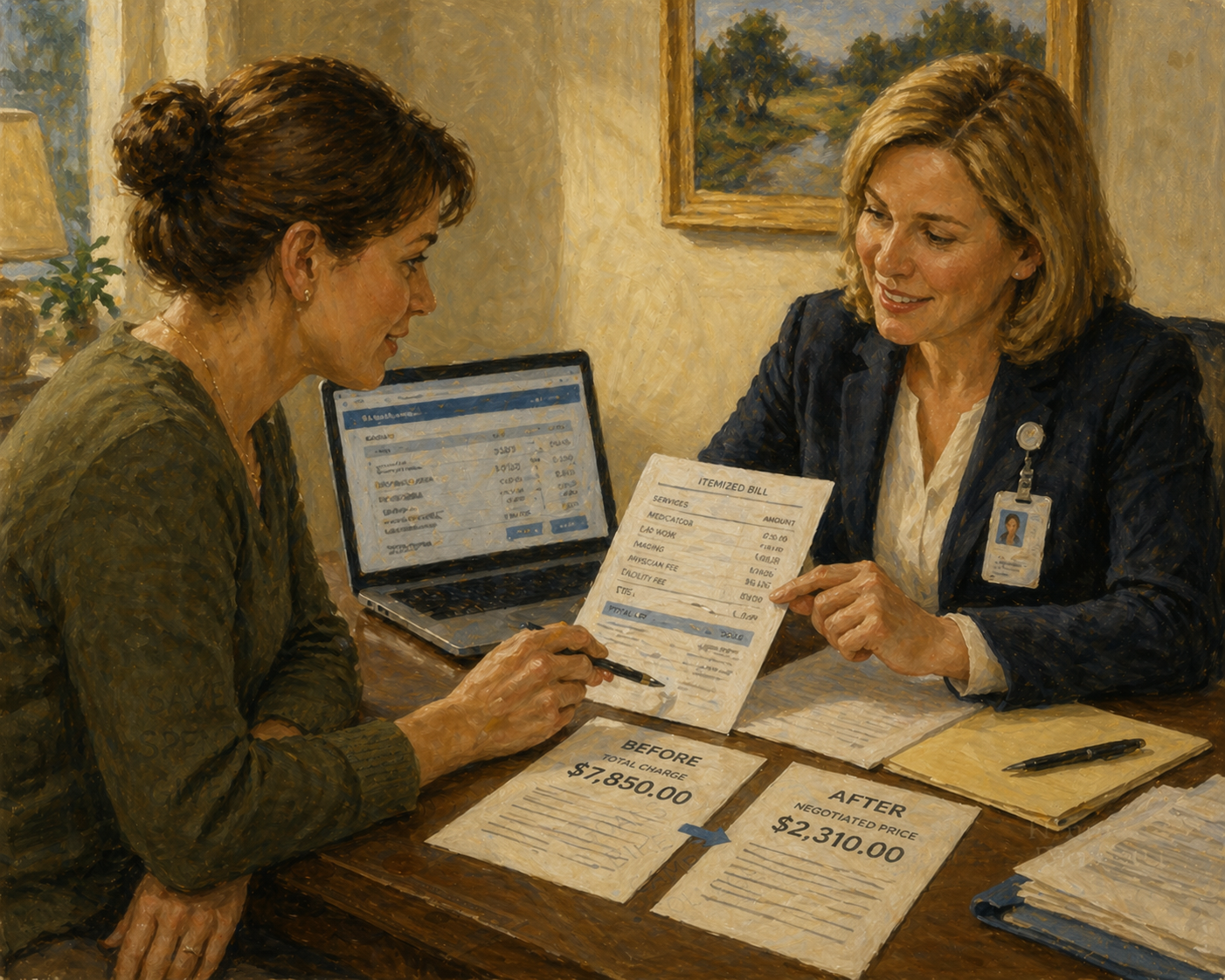
Medical bill negotiation for cash-pay patients involves leveraging the immediate payment benefit to providers in exchange for substantial discounts on inflated chargemaster rates. Hospitals frequently charge uninsured patients “chargemaster” rates that are 2-3 times higher than what insurers negotiate, but cash payments offer providers immediate revenue without administrative delays or denials. This guide outlines a step-by-step framework to navigate this process successfully.
Why Cash-Pay Patients Have Negotiation Power
Cash-pay patients often face inflated medical bills, but they also hold significant leverage due to the direct financial benefits they offer providers. Hospitals and clinics prefer immediate cash payments over the protracted process of insurance claims, which can involve delays, denials, and administrative overhead. For instance, negotiated rates by insurers average 58% of chargemaster prices, while cash prices average 64% of chargemaster prices, indicating that insurers often secure better upfront discounts than unnegotiated cash rates according to a Health Affairs analysis.
Prompt cash payment eliminates the administrative burden and financial uncertainty associated with insurance billing. Physicians in insurance-based practices spend approximately $99,000 annually per physician on administrative tasks like prior authorizations and claims as noted by StemWave. By eliminating these costs, providers are often willing to offer substantial discounts to cash payers. This understanding forms the foundation for successful negotiation, empowering patients to advocate for fairer pricing.
Step 1: Request an Itemized Bill Before You Pay Anything
Always request a fully itemized bill that details every charge, medication, and service rendered, including CPT (Current Procedural Terminology) or HCPCS (Healthcare Common Procedure Coding System) codes. This detailed breakdown is crucial for identifying potential errors and understanding the true cost of each service.
An itemized bill allows for a thorough review, as approximately 80% of medical bills contain at least one error according to Aptarro. Common errors include duplicate charges, services never received, or incorrect quantities of medications. Identifying these discrepancies is essential before any payment is made.
- Always demand a fully itemized bill with CPT/HCPCS codes.
- Scrutinize the bill for duplicate charges or services not rendered.
- Target high-cost items for negotiation using this detailed information.
Never agree to a payment plan or make any payment before meticulously reviewing and disputing the bill.
Step 2: Research Fair Market Rates for Your Procedures
Before engaging in negotiation, research the fair market rates for the specific medical procedures you received. This provides concrete data to support your proposed payment amount.
Use official tools to find benchmark pricing.
- Utilize Medicare payment lookup tools, such as the per A-Z Medical Billing.
- Consult independent resources like Healthcare Bluebook or FAIR Health Consumer for average cash prices in your geographic area. FAIR Health Consumer, for example, draws from over 52 billion healthcare claim records to provide estimates as stated by FAIR Health.
- Aim to negotiate a price between 120-150% of the Medicare rate as your target.
Document these researched rates to present as evidence during your negotiation calls.
Step 3: Contact the Billing Department with Your Negotiation Script
Initiate negotiation by contacting the hospital’s billing office directly, not a third-party collections agency. Ask to speak with a financial counselor or billing manager, as these individuals typically have the authority to negotiate.
Use a clear and direct negotiation script: “I am a cash-pay patient and would like to discuss a prompt-pay discount for immediate payment.” Present your research, citing Medicare rates and fair market prices, and propose paying approximately 140% of the Medicare rate. Maintain a calm, polite, and persistent demeanor throughout the conversation. It may take 2-3 calls to reach someone empowered to make a decision as demonstrated in a Slate article.
Step 4: Leverage Prompt-Pay Discounts and Financial Hardship Programs
Always inquire about prompt-pay discounts, which are typically offered for immediate payment and can range from 20-40% off the billed amount according to FC Billing. Many providers offer 10% discounts on office visits if payment is made within 14 days per the AOA.
If you face financial hardship, inquire about charity care or financial assistance programs. Most nonprofit hospitals offer 100% free care for incomes up to 200% of the Federal Poverty Level (FPL) and sliding-scale discounts up to 400% FPL reports HealthBillCentral. For a family of four, 200% FPL was $62,400 in 2024, with 2026 guidelines showing 2-3% annual increases according to HHS. If full payment is not feasible, request a 0% interest payment plan. Always get any agreed discount or payment terms in writing before making any payment.
Negotiation Strategies by Bill Size and Situation
This table helps cash-pay patients choose the right negotiation approach based on their bill amount and financial situation, maximizing their chances of success.
| Bill Amount | Best Strategy | Expected Discount | Timeline | When to Hire Help |
|---|---|---|---|---|
| Under $1,000 | Prompt-pay discount, direct negotiation with billing. | 20-40% | 1-2 calls, 1-2 weeks | Rarely needed. |
| $1,000-$5,000 | Prompt-pay, research fair rates (Medicare 120-150%), dispute errors. | 30-50% | 2-3 calls, 2-4 weeks | Consider if initial calls fail. |
| $5,000-$10,000 | Comprehensive rate research, charity care check, supervisor escalation. | 40-60% | 3-5 calls, 1-2 months | If negotiation stalls or complex. |
| $10,000-$25,000 | Charity care, detailed dispute, patient advocate involvement. | 50-70% | Multi-stage negotiation, 2-3 months | Highly recommended for expertise. |
| Over $25,000 | Medical billing advocate, legal counsel if necessary, formal dispute. | 60-80% | Several months to over a year | Essential for maximizing savings. |
Step 5: Escalate to Patient Advocates or Dispute Resolution
If the billing department refuses to negotiate a reasonable reduction, escalate your request. Ask to speak with the hospital’s patient advocate or ombudsman. These individuals are employed by the hospital to mediate patient concerns.
File a formal dispute in writing, clearly citing specific overcharges and requesting an itemized justification for each charge. Mention your consideration of filing a complaint with your state’s attorney general or health department as a last resort. For bills over $10,000, consider hiring a medical billing advocate, who typically charge 25-35% of the savings they achieve according to Medical Insurance Advocacy. Medical billing advocates achieve success rates of approximately 70% for first-level insurance appeals as reported by Medical Insurance Advocacy.
What to Do If Your Bill Goes to Collections
If a medical bill goes to collections, understand your rights before acting. Debt collectors must validate the debt in writing; always request verification and the original creditor’s contact information.
Negotiate directly with the collection agency. Collection agencies often buy debt for 10-20 cents on the dollar, making them willing to settle for 30-50% of the original amount. Never give collectors direct access to your bank account. Pay only by money order or cashier’s check after receiving the settlement agreement in writing. Check if the debt is past your state’s statute of limitations, which typically ranges from 3 to 10 years, with most states at 6 years according to SoloSuit’s 2026 guide. For instance, New York reduced its medical debt statute of limitations to 3 years in 2020 as noted by MMI.
Conclusion
Negotiating medical bills as a cash-pay patient is a powerful strategy to significantly reduce healthcare costs. By understanding your leverage, meticulously preparing with itemized bills and market research, and leveraging prompt-pay and financial assistance programs, you can achieve substantial savings. Most cash-pay patients can reduce their bills by 30-60% through persistent negotiation. Always get agreements in writing and maintain detailed records. Advocating for yourself is not only possible but expected by providers who value immediate, clean payments.
Frequently Asked Questions
How much can I realistically negotiate off my medical bill as a cash patient?
You can realistically negotiate 30-60% off your medical bill as a cash patient, often more for larger bills. Providers prefer immediate cash payment over lengthy insurance claims or collection processes, offering substantial discounts for prompt settlement.
What is a prompt-pay discount and how do I ask for it?
A prompt-pay discount is a reduction in your bill (typically 20-40%) offered for paying in full within a short timeframe, such as 30 days. To ask for it, call the billing department and state, “I’m a cash-pay patient and would like to discuss a prompt-pay discount for immediate payment.”
Can I negotiate medical bills after they’ve gone to collections?
Yes, you can negotiate medical bills after they’ve gone to collections. Collection agencies often buy debt for a fraction of its value, so they are usually willing to settle for 30-50% of the original amount. Always request debt validation and get any settlement in writing before paying.
What is the Medicare rate and why does it matter for negotiation?
The Medicare rate is the benchmark reimbursement amount that Medicare pays for a specific medical service, which you can look up using CPT codes. It matters for negotiation because it represents a fair, government-determined price, making 120-150% of the Medicare rate a reasonable target for cash-pay negotiations.
Do I have to pay a medical bill if I never received an itemized statement?
No, you should not pay a medical bill if you have not received an itemized statement. You have a right to a fully itemized bill showing all services and charges, which is crucial for identifying errors and understanding what you are being billed for.
How do I know if I qualify for charity care or financial assistance?
You may qualify for charity care or financial assistance if your income is below 200-400% of the Federal Poverty Level (FPL). Most nonprofit hospitals offer free care up to 200% FPL and sliding-scale discounts up to 400% FPL, and you can apply by contacting the hospital’s financial assistance department.
What should I do if the hospital refuses to negotiate my bill?
If the hospital refuses to negotiate, escalate by asking to speak with a patient advocate or ombudsman. You can also file a formal written dispute, and as a last resort, mention that you are considering a complaint with your state’s attorney general or health department.
Is it better to negotiate before or after paying part of the bill?
It is always better to negotiate before paying any part of the bill. Making a partial payment can weaken your negotiation leverage, as it signifies acceptance of the charges and reduces the incentive for the provider to offer a significant discount.
Can negotiating my medical bill hurt my credit score?
Negotiating your medical bill itself will not hurt your credit score. However, unpaid medical bills that go to collections can negatively impact your credit. A 2023 rule change states that medical debt under $500 will not appear on credit reports.
What documentation do I need to successfully negotiate a medical bill?
To successfully negotiate, you need a fully itemized bill with CPT codes, researched fair market rates (like Medicare rates), income documentation if applying for financial hardship programs, and detailed records of all communication and agreements.
Key Terms Glossary
Chargemaster Rates: The highest list prices for medical procedures and services, often significantly higher than what insurers pay.
CPT Codes: Current Procedural Terminology codes, which are standardized numerical codes used to describe medical, surgical, and diagnostic services.
HCPCS Codes: Healthcare Common Procedure Coding System codes, used to describe medical procedures, equipment, and supplies not covered by CPT codes.
Federal Poverty Level (FPL): A measure of income issued annually by the Department of Health and Human Services, used to determine eligibility for various federal programs and financial assistance.
Prompt-Pay Discount: A reduction in a medical bill offered by providers to patients who pay their bill in full within a specified short timeframe.
Medical Billing Advocate: A professional who helps patients understand and negotiate medical bills, appeal insurance denials, and resolve billing disputes.
Statute of Limitations: The legal time limit within which a lawsuit can be filed to collect a debt, varying by state and type of debt.
Charity Care: Financial assistance programs offered by hospitals, particularly nonprofit ones, to provide free or discounted care to eligible low-income patients.