Key Takeaways
- Dropping health insurance offers immediate financial relief but exposes individuals to significant medical debt risks.
- Uninsured individuals face average ER costs of $2,100-$2,715 for non-life-threatening conditions, potentially leading to bankruptcy.
- State-level individual mandates and penalties exist in California, Massachusetts, New Jersey, Rhode Island, and D.C.
- Alternatives like health sharing ministries (25% less than premiums) and direct primary care ($50-$100/month) offer cost-effective options.
- Catastrophic plans provide emergency protection with high deductibles ($10,600 in 2026) but lower premiums.
- The decision to drop coverage is most viable for young, healthy individuals with substantial emergency savings or access to robust alternatives.
Pros and Cons of Dropping Health Insurance Coverage
Deciding whether to drop health insurance is a complex financial and health decision, particularly in the evolving healthcare landscape of 2026. Many individuals consider this option due to rising premium costs, changes in employment, or a perception of good health.
However, this choice carries significant implications that extend beyond immediate monthly savings. This article will help you evaluate the full spectrum of financial and health risks, as well as explore viable alternatives, enabling an informed decision about your healthcare coverage.
The Financial Freedom of Dropping Health Insurance
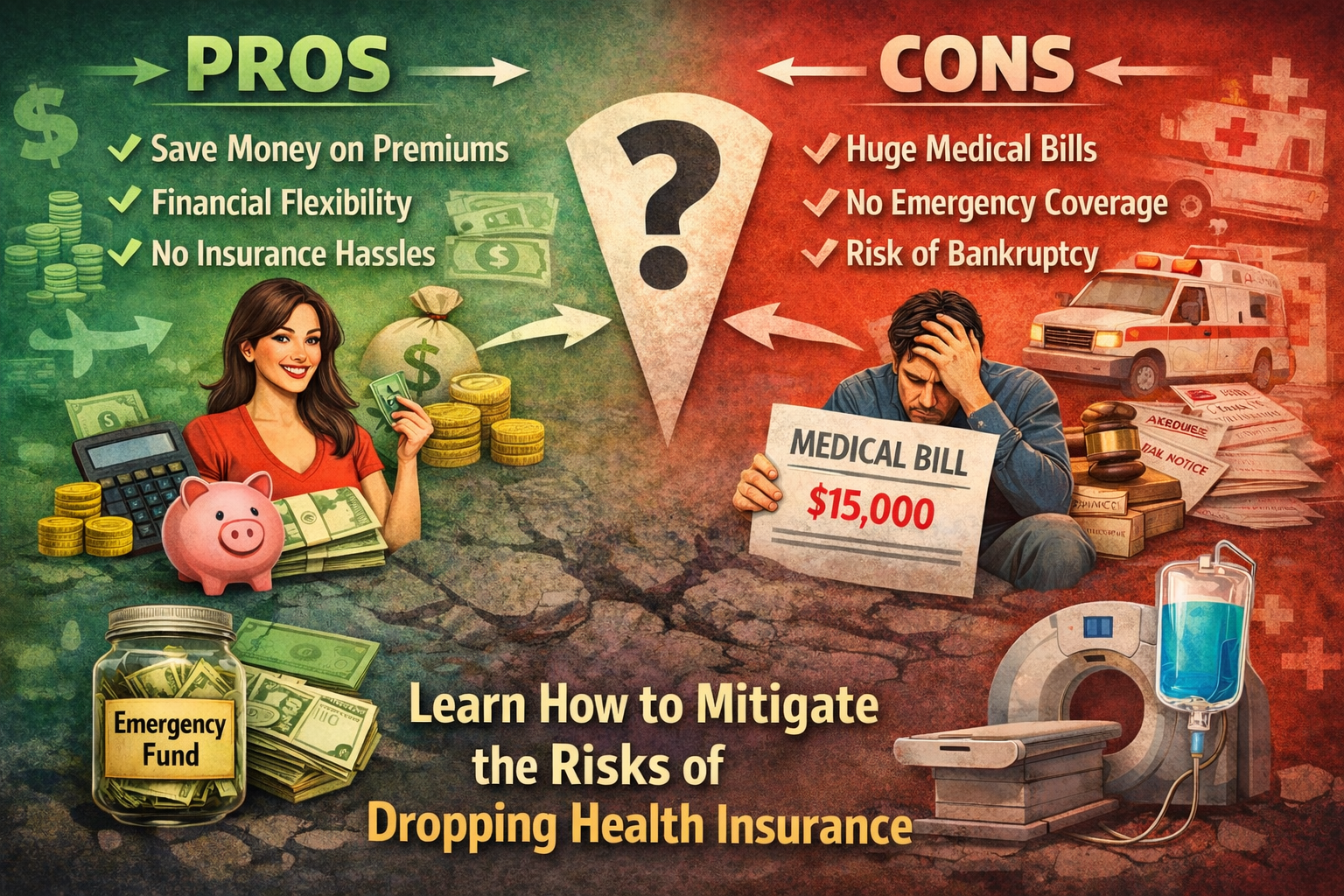
Dropping health insurance can offer immediate financial relief and increased cash flow. The most direct benefit is reclaiming monthly premium payments, which for individual coverage in 2026, averages around $50 per month for the lowest-cost plan after tax credits, though this is projected to increase significantly for many without enhanced subsidies according to CMS.
This reclaimed money can be redirected to other urgent financial needs, such as debt reduction, building an emergency fund, or investing. During periods of financial hardship, eliminating this fixed cost provides immediate breathing room. For those with substantial emergency savings, these reclaimed premium dollars can effectively become self-insurance, covering routine or unexpected medical costs without relying on a third-party payer.
- Immediate monthly savings boost cash flow.
- Freedom from premium payments during financial hardship.
- Funds can be redirected to urgent needs or investments.
- Flexibility to choose how and when to spend on healthcare.
- Building emergency savings with reclaimed premium dollars.
Control Over Your Healthcare Spending
Without health insurance, individuals adopt a pay-as-you-go approach, offering complete transparency and control over healthcare expenditures. This model allows for direct negotiation of cash-pay rates with providers, often resulting in lower costs than billed to insurance companies.
This approach also liberates individuals from network restrictions, referral requirements, and other bureaucratic hurdles. Patients can choose any provider without insurance limitations, directly accessing services like direct primary care (DPC) and cash-pay medical facilities. Telehealth options are also available at a fraction of insured visit costs, further expanding choices.
- Pay-as-you-go approach offers spending transparency.
- Negotiate cash-pay rates directly with providers.
- Avoid network restrictions and referral requirements.
- Freedom to choose any provider without insurance limitations.
- Access direct primary care and cash-pay medical services.
Simplified Healthcare Without Insurance Bureaucracy
Eliminating health insurance can simplify the healthcare experience by removing interactions with insurance companies. This means no more dealing with claim denials, appeals processes, or pre-authorization requirements that often delay care and create administrative burdens.
Individuals can establish direct relationships with healthcare providers, leading to clearer communication and transparent pricing before services are rendered. The risk of surprise bills from out-of-network providers is also removed, as all costs are agreed upon upfront. This reduction in administrative hassle frees up significant time and mental energy previously spent on insurance-related issues.
- No more dealing with insurance company denials and appeals.
- Eliminating pre-authorization requirements and paperwork.
- Direct relationships with healthcare providers.
- No surprise bills from out-of-network providers.
- Transparent pricing before receiving care.
The Cons: Understanding the Risks Briefly
While dropping health insurance offers perceived benefits, it exposes individuals to substantial financial and health risks. The most significant danger is the potential for catastrophic medical costs from unexpected illness or injury.
For instance, an emergency room visit for a non-life-threatening condition can range from $1,500 to $3,000, with many estimates around $2,100 to $2,715 based on recent analyses up to 2026. Without coverage, individuals face the full burden of these bills, potentially leading to medical debt and even bankruptcy, which affects up to 66.5% of bankruptcies in the U.S. according to World Population Review.
Additionally, some states, like California and Massachusetts, levy tax penalties for not having minimum essential coverage as noted by Venteur. Dropping coverage also means losing access to preventive care, which is often fully covered by insurance and crucial for early detection and management of health issues.
Insured vs. Uninsured: Real Cost Comparison
This table compares actual out-of-pocket costs for common medical scenarios with and without health insurance, helping readers understand the financial exposure they face when uninsured.
| Medical Scenario | With Insurance (Average) | Without Insurance (Average) | Potential Savings/Loss |
|---|---|---|---|
| Annual preventive care visit | $0 – $50 (copay) | $100 – $300 (cash rate) | Loss of $100 – $250 |
| Emergency room visit (moderate injury) | $412 – $646 (post-deductible) according to Bankrate | $2,100 – $2,715 according to BetterCare | Loss of $1,454 – $2,303 |
| Three-day hospital stay | $1,500 – $5,000 (deductible + coinsurance) | $15,000 – $30,000+ | Loss of $10,000 – $28,500+ |
| Prescription medications (monthly) | $10 – $70 (copay) | $50 – $500+ (full retail) | Loss of $40 – $430+ |
| Diagnostic imaging (MRI/CT scan) | $200 – $1,500 (after deductible) | $1,000 – $5,000+ | Loss of $800 – $3,500+ |
| Specialist consultation | $30 – $150 (copay) | $150 – $400 (cash rate) | Loss of $120 – $250 |
Smart Alternatives to Traditional Health Insurance
For those seeking alternatives to traditional health insurance, several options can provide varying levels of coverage and cost control. These often combine to create a more comprehensive solution.
- Health Sharing Ministries: These faith-based organizations involve members sharing medical costs. They typically cost 25% or less of traditional health insurance premiums according to The Actuary Magazine, with some like Solidarity HealthShare claiming 60% more affordability than traditional policies as per their website. However, they are not insurance and lack the same consumer protections.
- Direct Primary Care (DPC) Memberships: DPC models offer unlimited primary care services for a flat monthly fee, typically ranging from $50 to $100 per month for adults according to HealthInsurance.org. This covers routine and preventive care, often with wholesale pricing for labs and imaging.
- Catastrophic-Only Coverage: These plans have lower premiums but high deductibles, covering only major emergencies after a significant out-of-pocket expense. In 2026, deductibles are $10,600 for individuals according to AAPC. They are suitable for healthy individuals seeking protection against worst-case scenarios.
- Medical Cost-Sharing Apps and Community Programs: These platforms facilitate direct sharing of medical bills among members, often for specific conditions or within particular communities. They offer transparent pricing and community support.
- Discount Medical Programs: These programs offer reduced rates on medical services, prescriptions, dental, and vision care for an annual or monthly fee. They are not insurance but provide access to a network of providers offering discounted services.
Combining multiple alternatives, such as a DPC membership for routine care and catastrophic-only coverage for emergencies, can create a robust, lower-cost protection strategy.
When Dropping Coverage Makes Sense (And Why It Often Does)
For certain individuals, strategically opting out of traditional health insurance can be a financially sound decision, especially when paired with alternative coverage methods.
- Young and Healthy Individuals: Those with minimal healthcare needs and a high-risk tolerance may find the cost savings outweigh the risks.
- Substantial Emergency Savings: Individuals with a robust emergency fund (e.g., 6-12 months of living expenses) can use these savings as a self-insurance buffer against unexpected medical bills.
- Transitioning to Superior Alternatives: People actively moving to models like health sharing ministries combined with direct primary care often find these alternatives more cost-effective and tailored to their needs.
- Access to Cash-Pay and Negotiated Rates: Those who can effectively negotiate cash-pay rates with providers for routine care can significantly reduce costs.
- Moving Abroad: Individuals relocating to countries with universal healthcare systems or more affordable private insurance options may no longer need U.S. coverage.
- Self-Employed Individuals: Entrepreneurs and freelancers often have more flexibility to allocate healthcare dollars to alternatives that better suit their variable income and needs.
- Medicaid/CHIP Eligibility: Families or individuals who qualify for state-sponsored programs like Medicaid or CHIP may find themselves between traditional coverage, using these programs as a bridge.
- High Deductibles Already: Many insured individuals with high-deductible plans already pay most costs out-of-pocket, making the perceived value of premiums low.
- States Without Individual Mandate Penalties: Individuals residing in states without penalties for being uninsured face less financial risk from the government.
- Access to Community Health Centers: Proximity to community health centers or sliding-scale clinics provides a safety net for affordable primary care.
- Early Retirees: Those bridging to Medicare can use alternative coverage strategies to manage costs until they qualify for government programs.
The percentage of uninsured Americans is projected to rise, with 4.8 million additional people becoming uninsured in 2026 if enhanced ACA premium tax credits expire according to the Urban Institute. This indicates a growing segment of the population navigating healthcare without traditional insurance.
Conclusion: Making an Informed Decision
The decision to drop health insurance coverage is a deeply personal one, requiring a careful assessment of your financial situation, health status, and risk tolerance. While the immediate financial relief from eliminating premium payments can be appealing, especially with rising healthcare costs, the potential for catastrophic medical debt remains a significant concern.
Before making this choice, thoroughly investigate smart alternatives like health sharing ministries, direct primary care, or catastrophic-only plans. Understand the specific regulations and potential penalties in your state, and ensure you have a robust emergency fund to act as self-insurance. An informed decision balances potential savings with adequate protection against unexpected health events.
Frequently Asked Questions
What happens if I drop my health insurance and then get sick?
If you drop health insurance and then get sick, you will be responsible for 100% of your medical bills. You may need to pay cash rates, which can be significantly higher than insured rates, and will not be able to re-enroll in a traditional plan until the next open enrollment period unless you qualify for a special enrollment period due to a major life event. For severe illnesses, this can lead to substantial medical debt.
How much money will I actually save by dropping health insurance?
Your actual savings by dropping health insurance depend on your current premium costs, which can vary widely. While you will save the monthly premium amount, these savings are contingent on remaining healthy. An unexpected illness or injury could result in out-of-pocket costs far exceeding any premium savings, such as an average emergency room visit costing $2,100 to $2,715 without insurance.
Can I get health insurance back if I drop it?
Yes, you can typically get health insurance back if you drop it, but usually only during the annual open enrollment period (typically November 1st to January 15th). You may also qualify for a Special Enrollment Period if you experience a qualifying life event, such as marriage, birth of a child, or loss of other coverage. However, there might be a gap in coverage between dropping your plan and re-enrolling.
Will dropping health insurance affect my taxes?
At the federal level, the Affordable Care Act’s individual mandate penalty was eliminated starting in 2019, so there is no federal tax penalty for not having health insurance in 2026. However, five states and the District of Columbia (California, Massachusetts, New Jersey, Rhode Island, and D.C.) enforce state-level individual mandates with financial penalties that could affect your state tax return as of 2026.
What is the cheapest alternative to dropping health insurance completely?
The cheapest alternatives to completely dropping health insurance often involve a combination of strategies. Catastrophic health plans offer low premiums with high deductibles, covering major emergencies. High-deductible health plans (HDHPs) are another option, especially when paired with a Health Savings Account (HSA). Eligibility for Medicaid or significant marketplace subsidies can also provide very low-cost or free comprehensive coverage, with the lowest-cost plans after tax credits averaging $50/month in 2026 according to CMS.
Is it worth keeping health insurance if I’m young and healthy?
For young and healthy individuals, keeping health insurance is often still recommended due to the unpredictable nature of health crises. While unlikely, a severe accident or sudden illness can result in overwhelming medical bills. Insurance also covers preventive care, which is crucial for long-term health. Alternatives like catastrophic plans or direct primary care combined with emergency savings can be viable for those with strong risk tolerance.